Most video ads don't fail because the product is bad. They fail because the angle is wrong. The same product can flop with one script and sell well with another, just by changing how the story is told.
An angle is the reason you give someone to care. Is it the problem they have? The result they want? The thing they believe that's stopping them from buying?
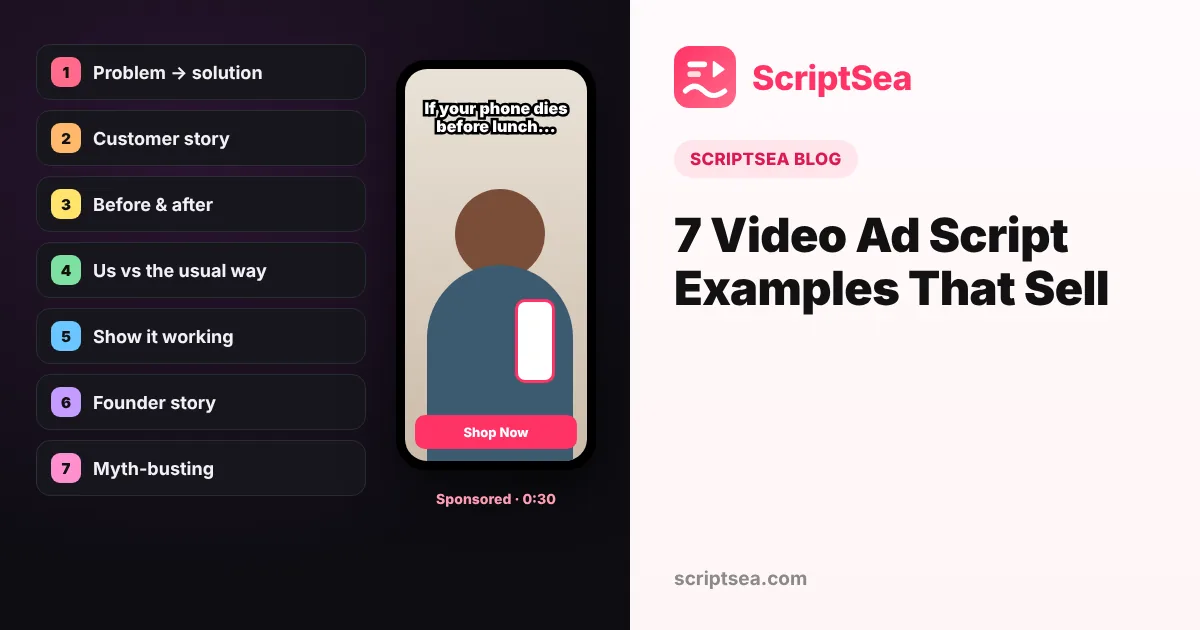
Below are 7 video ad angles that work again and again for Facebook, Instagram and TikTok ads, each with a full example script you can adapt. They're written for a 30-second ad, which is about 70 to 80 words.
How to pick an angle
Before the examples, one quick rule: match the angle to how much your viewer already knows.
- Cold audience (never heard of you): lead with the problem, a surprising myth or a before and after. They need a reason to care before they hear your name.
- Warm audience (knows the problem, comparing options): comparisons, demos and customer stories work well. They want to know why yours.
- Hot audience (knows your brand, hasn't bought): founder stories, offers and proof. They need a final push.
We go deeper on this in how to write a product video ad script for cold, warm and hot audiences.
1. Problem and solution
The classic. Open on the pain, make it felt, then show the product as the relief.
Best for: cold audiences and products that fix a clear, annoying problem.
"If your phone dies before lunch every single day, this is for you.
I was carrying a charger, a cable and a power bank everywhere. My bag was a mess.
This is a power bank that clips straight onto the back of my phone. No cable. It just sticks on and charges.
I clip it on in the morning and I'm still on 60% at night.
Link's right here. It's the one thing I'd buy again tomorrow."
Why it works: the first line calls out exactly who it's for. The "before" is specific, and the proof is a number people can picture.
2. Customer story
A customer telling a friend what changed for them. It's the most natural UGC format.
Best for: warm audiences, and products with strong real reviews.
"Okay, I have to tell you about this pillow, because my neck hasn't hurt in two weeks.
I'd wake up every morning with a stiff neck. I tried three pillows. Nothing.
My sister had this one, so I tried hers when I stayed over. Woke up feeling normal for the first time in months.
I ordered my own the next day.
If you wake up sore, just try it. They do a trial, so you can send it back."
Why it works: it sounds like a recommendation, not an ad. Keep it honest, though. Customer story ads should reflect what real customers have actually said, not invented experiences.
3. Before and after
Life before the product, the moment of switching, life after.
Best for: cold audiences, and products with a visible result.
"This was my desk three months ago. Cables everywhere. I couldn't find anything.
I spent one Saturday afternoon with this cable kit. Clips, sleeves and a tray that mounts under the desk.
This is my desk now.
Same desk, same stuff. I just actually want to sit here now.
It's about $30, and it's the best $30 I spent this year. Link below."
Why it works: the viewer sees the change instead of hearing about it. On screen, the before and after shots do most of the selling.
4. Comparison: us vs the usual way
Show why the common fix fails and why yours works. Don't name or attack a competitor. Compare against the usual way of doing things.
Best for: warm audiences who already know the problem and are choosing a fix.
"I used to clean my shower with sprays and a sponge every week. It still went pink and gross in the corners.
Then I got this. You stick it to the wall, and it sprays the whole shower after every use.
No scrubbing. It just stays clean.
I've refilled it twice in three months, and I haven't scrubbed once.
If you hate cleaning the shower, tap the link."
Why it works: it agrees with the viewer about the frustrating "usual way" first, then offers a better one.
5. Show it working
A hands-on demo or unboxing, narrated in the moment.
Best for: products that are satisfying or surprising to watch.
"Watch this. Red wine on a white couch.
I'm just going to spray it, wait ten seconds, and wipe.
Gone. Completely gone.
It works on carpet, car seats and clothes too. I keep one in the kitchen and one in the car.
If you've got kids or a dog, you need this. It's on the link below."
Why it works: the proof happens right in front of the viewer. A demo answers "does it work?" faster than any claim.
6. Founder story
Why the product was made, the problem the founder had, and what makes it different.
Best for: hot audiences, retargeting and brands with a real story.
"I started this company because I couldn't find a sunscreen that didn't leave a white cast on my skin.
I tried everything. Either it looked chalky in photos, or it felt greasy all day.
So I spent two years working with a lab to make one that disappears on every skin tone.
This is it. It goes on clear, and you can wear it under makeup.
If you've been looking for this too, it's here. Link below."
Why it works: people buy from people. A founder who had the problem themselves is more believable than a brand claim.
7. Myth-busting
Break a belief that stops people from buying, then show the truth.
Best for: cold audiences, and products people have doubts about.
"Everyone thinks you need an expensive coffee machine for good coffee at home. You don't.
This is a $25 hand press. Hot water, ground coffee, press, done.
It makes the same strong, smooth coffee I used to pay $5 for every morning.
I've saved over $100 in my first month.
Don't buy the $800 machine yet. Try this first. Link's below."
Why it works: it removes the main objection, "it's too expensive", in the first line.
What every ad script needs
Whatever angle you use, check your script has these five things:
| Part | What it does |
|---|---|
| Hook | Stops the scroll in the first 3 seconds, with sound on or off |
| Problem or desire | Makes the right viewer think "that's me" |
| Product | Shown in hand, named simply |
| Proof | A demo, a number, a review or a visible result |
| Call to action | One clear next step |
If one is missing, that's usually why the ad isn't converting.
Test angles, then hooks
Don't run one ad and decide whether a product works. Run two or three angles, see which one wins, then test different hooks on the winning angle. Our guide on how to test video ad hooks walks through it step by step, even on a small budget.
Get ad scripts from your product link
Writing seven angles by hand takes hours. ScriptSea's UGC Ad Script Generator reads your product page, picks up the product, offer and real reviews, and writes ad scripts in the angle you choose, plus extra hooks to test and AI video prompts if you want to make the video with AI. It only uses facts from your page, so it won't invent reviews or discounts.
Try ScriptSea free
ScriptSea writes video ad scripts from your product link, with hooks to test and AI video prompts for every scene. Try ScriptSea free. You get 3 free scripts, no card needed.