Here's a mistake almost every new advertiser makes: one ad, shown to everyone.
The person who's never heard of you, the person comparing three options and the person who left your checkout yesterday all see the same video. It's too pushy for the first one, too vague for the second and too slow for the third.
A good product video ad starts with one question: what does this viewer already know? Answer that, and the script almost writes itself. Here's how to research your product, then write a script for each stage, with examples.
Start with the product page, not a blank page
The best ad scripts are built from things that are already true. Before you write a line, pull these from your product page and reviews:
- The main problem it solves. In the customer's words, not yours.
- The one result people mention most. Look for the phrase that shows up again and again in reviews.
- The biggest objection. Price, "will it work for me", "is it worth it". Reviews and questions often reveal it.
- Proof you can show. A demo, a before and after, a number, a review quote.
- The offer. Price, bundle, guarantee, free shipping, if you have one.
Reviews are gold. If several customers write "I can finally sleep through the night", that line is better ad copy than anything you'd invent. Just stick to what customers actually said. Don't make up reviews, results or discounts.
The three audience stages
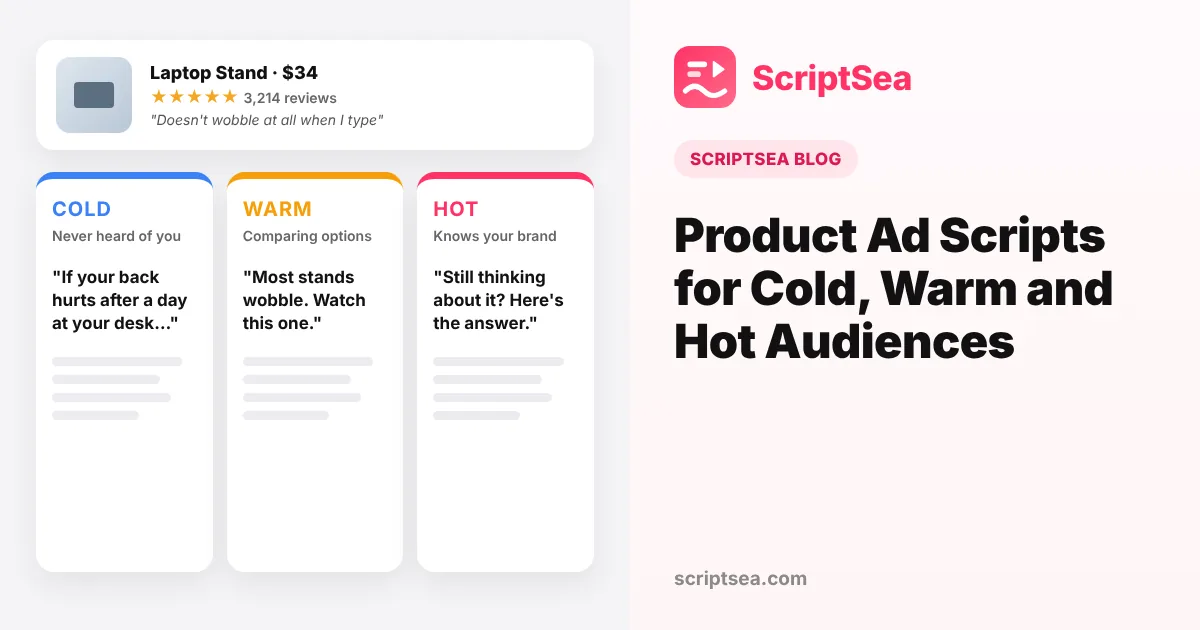
Copywriters have used the idea of awareness stages for decades. For video ads, a simple version with three stages is enough:
| Stage | What they know | What the ad needs to do |
|---|---|---|
| Cold | They don't know you, and may not know they have the problem | Make them notice the problem or the result |
| Warm | They know the problem and are looking at options | Show why your product is the better choice |
| Hot | They know your brand but haven't bought | Remove the last doubt and give a reason to act now |
Each stage needs a different opening, a different amount of explaining and a different call to action.
Cold audience scripts: lead with the problem or the result
Cold viewers don't care about your brand yet. They care about themselves. So the first seconds have to be about their problem or a result they'd want, not your product name.
What works: problem callouts, surprising facts, myth-busting, before and after.
What to avoid: opening with your logo or brand name, and long feature lists.
"If your back hurts after a day at your desk, it might not be your chair.
Most of us sit with our screen too low, so we look down all day. That strain goes straight into the neck and upper back.
I put my laptop on this stand. It lifts the screen to eye level, folds flat and fits in my bag.
The first week, I noticed I wasn't rubbing my neck at 4pm anymore.
If you work on a laptop, try raising your screen. This is the stand I use. Link below."
Notice the product doesn't show up until the third line. The first two lines earn the right to talk about it.
Warm audience scripts: show why yours
Warm viewers know the problem. They might have tried a fix already. Now they want to know why your product is better than the other options.
What works: comparisons against the usual way, demos, customer stories, specific proof.
What to avoid: spending too long explaining a problem they already know.
"You've probably tried a laptop stand already. Most of them wobble when you type.
This one has a wide aluminium base, so it stays put. Watch, I'll type as hard as I can. Nothing.
It adjusts to six heights, and it folds to the size of a notebook.
It's got over 3,000 reviews, and the thing people mention most is that it doesn't wobble.
If you want a stand you'll actually keep using, it's on the link."
The script skips the "why your neck hurts" part, because this viewer already knows. It goes straight to the difference.
Hot audience scripts: remove the last doubt
Hot viewers have visited your site, watched your videos or added to cart. They're close. Something is holding them back: price, doubt, timing.
What works: handling the main objection, guarantees, founder stories, offers, short reminders.
What to avoid: starting from scratch as if they've never seen you.
"Still thinking about the stand? Here's the honest answer to the question we get the most.
'Will it fit my laptop?' If your laptop is between 10 and 17 inches, yes.
And if it's not right for you, you can send it back within 30 days.
It's the same stand you looked at, and it ships today.
Tap the link and it's yours."
Short, direct and focused on the one thing stopping them. Only mention a guarantee or offer you actually have.
Fit the script to the format
The stage tells you what to say. The format tells you how it looks:
- UGC style: a person talking to the phone. Feels native in the feed and works at every stage.
- Demo: the product in action. Strong for warm audiences who want proof.
- Founder to camera: builds trust with hot audiences.
- Text and B-roll: product shots with big on-screen text. Good for quick reminders and offers.
Whatever the format, put the key line on screen as text. Plenty of people watch ads with the sound off.
If you're writing UGC style, our guide on how to write a UGC ad script that sells goes deeper on that format, and 7 video ad script examples shows one script for each common angle.
How long should a product ad be?
A good starting point:
- Cold: 20 to 45 seconds. You need time to set up the problem.
- Warm: 15 to 30 seconds. Get to the proof fast.
- Hot: 6 to 20 seconds. A quick reminder and a reason to act.
At a natural speaking pace, 30 seconds is about 70 to 80 words. Write long, then cut. The parts to cut first are features the viewer doesn't care about at that stage.
Common mistakes
- One ad for everyone. Too much for cold viewers, too little for hot ones.
- Leading with the brand name to people who've never heard of you.
- Inventing proof. Made-up reviews or fake discounts damage trust and can break advertising rules.
- Listing every feature. Pick the one or two that matter at that stage.
- A vague call to action. "Check it out" is weaker than "Tap the link, it ships today".
Write all three scripts from one link
Researching a product page and writing three versions for three audiences takes time. ScriptSea's UGC Ad Script Generator reads your product link for the product, offer and real reviews, lets you pick cold, warm or hot, and writes the ad script for that stage, with extra hooks to test. It shows you which facts it used, so you can check them before you run the ad.
Try ScriptSea free
ScriptSea writes product ad scripts for cold, warm and hot audiences from your product link, plus AI video prompts for every scene. Try ScriptSea free. You get 3 free scripts, no card needed.