When a video ad doesn't work, most people throw the whole thing away and start over. New script, new footage, new everything. That's slow, expensive and usually unnecessary.
Very often the body of the ad is fine. The problem is the first three seconds. Nobody stayed long enough to hear the good part.
Hook testing fixes that. You keep the same ad and change only the opening, then let the numbers tell you which one people stop for. Here's how to do it, even if you're spending a small amount each day.
Why test hooks first
The hook is the part of your ad most people see. Everyone who's shown the ad sees the first second. Far fewer see the middle, and fewer still see the end.
So a small improvement in the hook affects more people than a big improvement anywhere else. And it's the cheapest part to change: you don't need a new shoot, just a new first line and a new first shot.
Change one thing at a time. If you change the hook, the body and the call to action all at once, you won't know which change made the difference.
Step 1: Start with one body
Write or film one ad body you believe in: the problem, the product, the proof and the call to action. This stays the same in every version.
If you don't have a solid body yet, start there. Our 7 video ad script examples give you a script for each common angle.
Step 2: Write 3 to 5 hooks from different angles
Don't write five hooks that say the same thing in slightly different words. Make them genuinely different, so the test teaches you something:
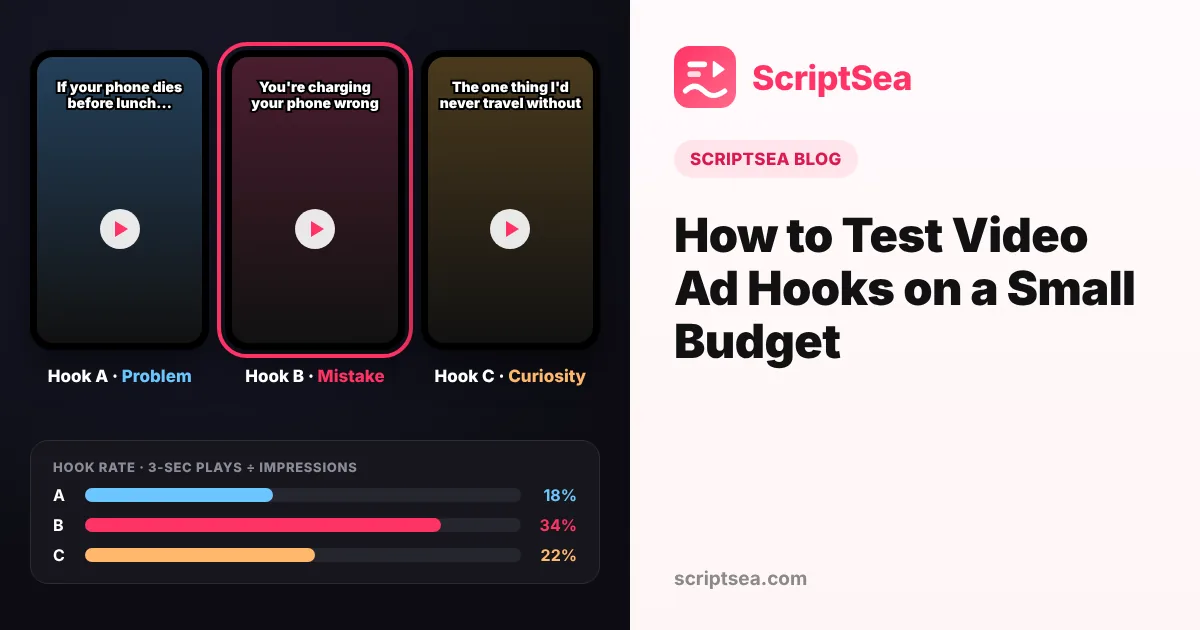
Problem: "If your phone dies before lunch, watch this."
Result: "I'm still on 60% battery at 10pm. Here's why."
Mistake: "You're charging your phone wrong, and it's killing your battery."
Curiosity: "This is the one thing I'd never travel without again."
Visual: Open on the power bank clicking onto the phone, with the text "No cable. Just click."
Each hook needs a matching first frame and on-screen text, since lots of people watch ads with the sound off. Then cut each hook onto the same body so you have 3 to 5 versions of the ad.
Need more hook ideas? See 50 video hook examples, or get 10 for your product from our free Video Hook Generator.
Step 3: Set up the test
Keep everything else equal, so the hook is the only difference:
- Same audience, same budget, same placements for every version.
- Put the versions in the same ad set or ad group, or use your ad platform's built-in creative testing, so they compete fairly.
- Launch them at the same time. Results change by day of the week.
- Don't edit the ads while they run. Edits can reset learning and muddy the result.
On a small budget, test fewer hooks at a time. Three versions with enough spend each will teach you more than eight versions that barely run.
Step 4: Read the right numbers
Different numbers tell you about different parts of the ad. In Meta Ads Manager you can add columns for 3-second video plays and ThruPlays, and from those, many advertisers work out two simple ratios:
| Number | How it's usually worked out | What it tells you |
|---|---|---|
| Hook rate | 3-second video plays ÷ impressions | Did the opening stop the scroll? |
| Hold rate | ThruPlays ÷ 3-second video plays | Did the rest of the ad keep them? |
| Click-through rate | Link clicks ÷ impressions | Did they want to learn more? |
| Cost per result | Spend ÷ purchases or leads | Did it actually make money? |
"Hook rate" and "hold rate" aren't official platform names, and people calculate them slightly differently. That's fine, as long as you use the same method for every version.
For a hook test, look at the hook rate first. If one hook clearly stops more people, it's doing its job. But the final decision should come from cost per result. A hook that stops lots of the wrong people isn't a winner.
TikTok Ads Manager has similar video metrics, like 2-second and 6-second views, which you can use the same way.
Step 5: Give it enough data
The most common mistake is calling a winner too early. One hook gets two sales on day one and looks like a genius. By day four, it's average.
A few practical rules:
- Let each version spend a meaningful amount before you judge. A common rule of thumb is at least one to two times your target cost per purchase, per version.
- Wait a few days if your budget is small, so you're not reading one lucky afternoon.
- Look for a clear gap. If two hooks are close, treat them as a tie and test something more different next round.
Step 6: Keep the winner and test again
Once you have a winner:
- Keep it running and give it more budget, gradually.
- Make new hooks in the same style as the winner. If the mistake hook won, write three more mistake hooks.
- Then test the body, keeping the winning hook. Try a different proof point or a shorter version.
Over a few rounds, you build an ad where every part has beaten an alternative. That's how small accounts find ads that scale without guessing.
Common hook testing mistakes
- Changing several things at once. You learn nothing about the hook.
- Hooks that are too similar. Five versions of the same line won't show a difference.
- No on-screen text. Muted viewers judge the first frame alone.
- Judging on likes or views alone. Cheap views don't mean cheap sales.
- Calling it after one day. Small numbers swing wildly.
- Stopping after one test. The first winner is a starting point, not the finish line.
Make the hooks faster
The slow part of hook testing is writing enough genuinely different hooks for every product. ScriptSea's UGC Ad Script Generator writes the ad script from your product link and gives you extra hooks to test with it, plus on-screen text. If you make your ads with AI, it writes the video prompts too.
Try ScriptSea free
ScriptSea writes video ad scripts and hooks to test from your product link, plus AI video prompts for every scene. Try ScriptSea free. You get 3 free scripts, no card needed.