A UGC ad works because it doesn't look like an ad. It looks like a real person on their phone telling you about something they found. That's the whole trick, and it's also why most UGC ads fail.
The moment it sounds like a script, people swipe. The moment it rambles, people swipe. The good ones feel natural but are planned down to the second.
Here's how to write a UGC ad script that feels like a recommendation from a friend and still does its job: stop the scroll, show the product, and get the click.
What makes UGC ads different
A normal ad sells from the brand's point of view. A UGC ad sells from the customer's point of view.
That changes the language. Brands say "our innovative formula". People say "I didn't think this would work, but". Brands list features. People talk about the one thing that changed for them.
It also changes the look. Vertical video, natural light, a real room, a person talking straight to the phone. It should look like it belongs in the feed between a friend's story and a meme. If it looks like a TV ad, people treat it like one.
The 4-part UGC ad structure
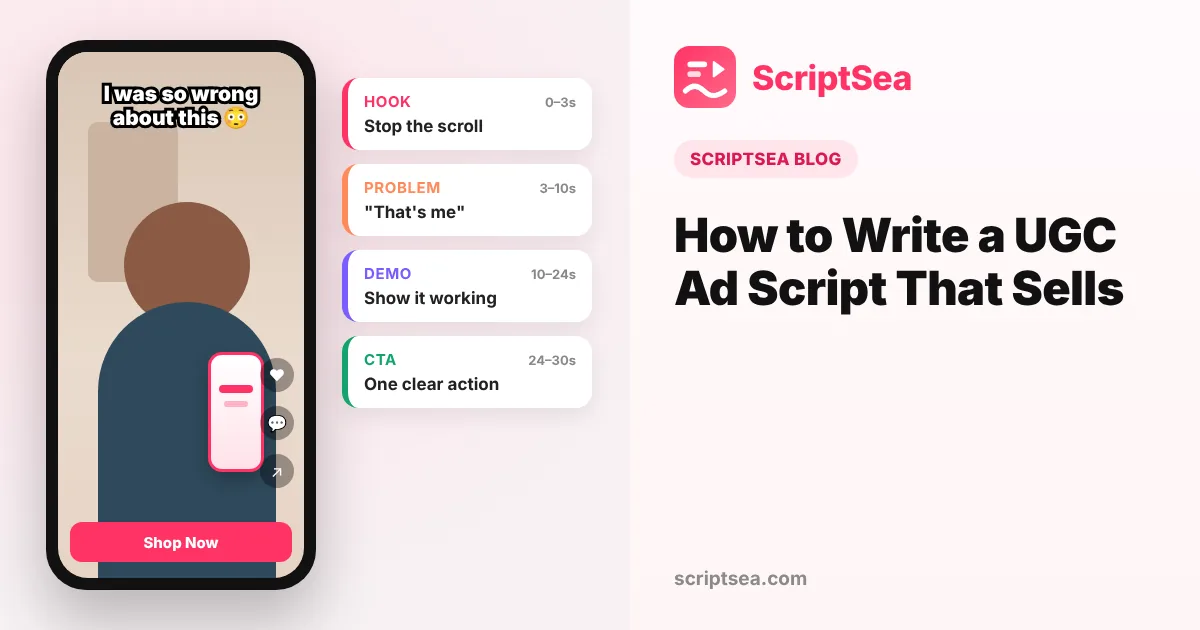
Almost every UGC ad that works follows the same four beats:
| Part | Time (30s ad) | Job |
|---|---|---|
| Hook | 0 to 3s | Stop the scroll |
| Problem | 3 to 10s | Make the viewer think "that's me" |
| Product and proof | 10 to 24s | Show it working, not just talk about it |
| Call to action | 24 to 30s | Tell them exactly what to do next |
The hook is the biggest one by far. If people don't get past the first 3 seconds, nothing else in the script matters. In ad accounts, the share of people who watch past those first seconds is often called the hook rate, and it's usually the first number to check when an ad isn't working.
Hooks that stop the scroll
A UGC hook has to work with the sound off, because a lot of people scroll muted. So the first frame and the first line both have to do the work. Put the hook on screen as text too.
Here are hook styles that work again and again:
- The confession: "I was so wrong about this."
- The problem callout: "If your feet hurt by 3pm, watch this."
- The result first: "This is my skin after 14 days."
- The objection: "I thought this was a scam. It's not."
- The comparison: "I tried the $60 one and the $15 one. Here's the difference."
- The discovery: "Why did nobody tell me about this sooner?"
Notice none of them start with the brand name. People don't stop for a brand they don't know. They stop for a problem they have or a result they want. The brand can come a few seconds later.
Write five hooks for every ad, not one. The body can stay the same. Testing different hooks on the same video is the cheapest way to find a winner.
Need more options? Our free Video Hook Generator gives you 10 first lines for any product in different styles.
The problem: make them feel seen
After the hook, spend a few seconds on the problem. Not a lecture. Just enough that the right viewer nods.
Be specific. "My skin was bad" is weak. "I had these dry patches around my nose that makeup just sat on top of" is strong. The detail is what makes it believable, and it's what makes the right person think "that's exactly my problem".
Keep it short. Two or three lines. You're setting up the product, not telling your life story.
Product and proof: show, don't list
This is where weak scripts list features. Strong scripts show one or two things happening.
- Show the product in hand, in the first second it's mentioned.
- Show it being used, the way a normal person would use it.
- Show the result, or the moment of difference.
- Pick the one or two benefits that matter most. Not all seven.
Then add one line of proof. A specific number, a before and after, or the reason it works in plain words.
Weak: "It has hyaluronic acid, ceramides, niacinamide and vitamin E."
Strong: "I put it on at night, and in the morning the dry patches were just gone. That's it. That's the review."
The call to action: one clear next step
Tell people exactly what to do. One action, said simply.
- "Tap the link and grab one before the sale ends."
- "Click below, they've got a bundle that saves you about $20."
- "Shop Now. I'd get two."
If there's a real reason to act now, like a sale or limited stock, say it. If there isn't, don't make one up. Fake urgency is easy to spot, and it costs you trust.
A simple 30-second UGC ad script template
Fill in each line, then read it out loud. If any line sounds like a brochure, rewrite it the way you'd text it to a friend.
Hook (0 to 3s): [Problem callout, result or confession, under 10 words]
Problem (3 to 10s): [The specific annoying thing, in 2 short lines]
Product (10 to 17s): [Show it, name it, one line on what it is]
Proof (17 to 24s): [Show it working, one specific result]
CTA (24 to 30s): [One clear action, plus a reason if there's a real one]
At a natural speaking pace, 30 seconds is about 70 to 80 words. If your script is longer, cut. Ads almost always get better when they get shorter.
Two full UGC ad script examples
Example 1: posture corrector
"I didn't know my back pain was coming from how I sit.
I work at a desk all day, and by 4pm my neck and shoulders were killing me.
My physio friend told me to try one of these. It goes on under your shirt, and you can't even see it.
It gently pulls your shoulders back, so you stop slouching without thinking about it. Two weeks in, the 4pm neck ache is basically gone.
The link's right below. If you sit at a desk, just try it."
That's about 80 words. One problem, one product, one result, one action.
Example 2: meal prep containers
"Okay, these containers fixed my lunch situation.
I was spending like $15 every day on lunch because my old containers leaked all over my bag.
These ones click shut on all four sides. Watch. Upside down, shake it. Nothing.
They go in the microwave and dishwasher, and they stack flat in the fridge.
I've saved so much money just by bringing lunch again. Tap below, they've got a 10-pack."
The demo line, "Upside down, shake it. Nothing", is the strongest moment in the ad. It proves the claim in one second instead of describing it.
Tips for filming and AI-made UGC
- Keep it real-looking. Natural light, a real room, phone-style framing. Polished studio footage usually performs worse in this format.
- Add captions. Big, readable captions help the many people who watch muted.
- Change the shot every few seconds. Cut to the product, a close-up, the result. It holds attention.
- Make several versions. Same body, different hooks. Let the numbers pick the winner.
If you're making UGC-style ads with AI creators, keep the creator presenting the product, not pretending to be a real customer with a personal story that never happened. Platforms like TikTok ask you to label realistic AI-generated content, and in the US the FTC's rule on fake reviews and testimonials covers testimonials from people who don't exist. Check the rules for the platforms and countries you advertise in.
Common UGC script mistakes
- Starting with the brand name. Nobody stops for a logo.
- Reading like an ad. "Introducing" and "revolutionary" are instant swipes.
- Too many features. Pick the one or two that matter.
- No demo. Saying it works is weak. Showing it work is strong.
- A vague CTA. "Check it out" is weaker than "Tap the link and get the bundle".
- One hook only. You won't know what works until you test a few.
Try ScriptSea free
ScriptSea's UGC Ad Script Generator writes a full UGC ad script with hooks, a demo and a call to action in seconds, plus AI video prompts for every scene if you make your ads with AI. Try ScriptSea free. You get 3 free scripts, no card needed.