The hook is the first line of your video. It's also the line that decides whether anyone hears the second one.
You can have a great idea, good lighting and a clean edit, and still lose most people in the first two seconds. Not because the video is bad, but because the opening didn't give them a reason to stay.
Below are 50 video hook examples sorted into 10 types. Each type works for a different reason, so you'll also see when to use it. Swap in your own topic, keep the shape, and you've got a hook.
What makes a hook work
Every good hook does the same job: it opens a question in the viewer's head that they want answered.
"Your phone battery hates being at 100%" makes you ask why. "I spent $2,000 testing cheap headphones" makes you ask which ones won. The video is the answer. The hook is the question.
A few things almost every strong hook has in common:
- It's short. Most work at under 12 words.
- It's specific. Real numbers, real objects and real places beat vague words.
- It starts with the interesting part. No greeting, no intro, no "so today".
- The first frame matches it. If you say "look at this", show it right then.
Say the hook and show it at the same time. Lots of people scroll with the sound off, so put the hook on screen as text too.
1. Result first
Lead with the outcome. People stay to see how you got there.
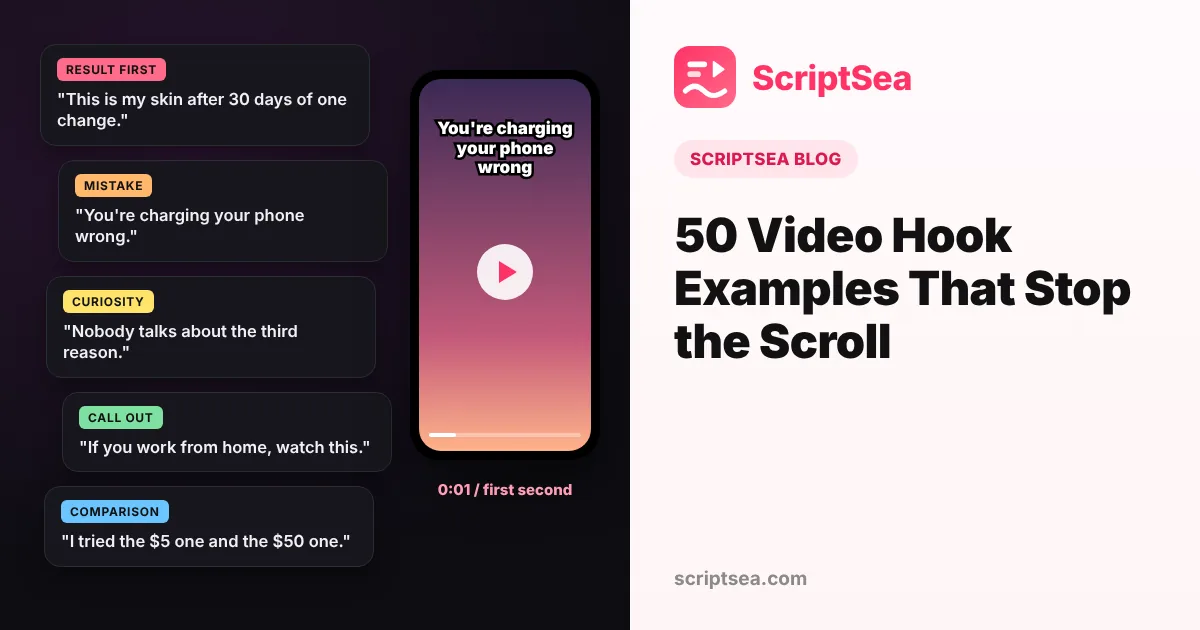
- "This is my skin after 30 days of one change."
- "I grew this channel from 0 to 10,000 subscribers with one type of video."
- "This $12 tool replaced three things in my kitchen."
- "Here's what 6 months of daily walking did to my sleep."
- "This room cost me $200 to make over."
Use it when: you have a clear before and after, or a number that makes people curious.
2. The mistake
Point out something people are doing wrong. Nobody wants to be the one making the mistake.
- "You're charging your phone wrong."
- "Stop putting your hook at the end of the sentence."
- "This is why your bread comes out flat."
- "Most people stretch before running. That's backwards."
- "If you rinse rice like this, you're wasting your time."
Use it when: you can name a common habit and explain a better way. Make sure you're right, or the comments will tell you.
3. Curiosity gap
Give part of the answer and hold back the rest.
- "There's a reason plane windows are round, and it's darker than you think."
- "Nobody talks about the third reason restaurants fail."
- "I found out why my videos stopped getting views. It wasn't the algorithm."
- "There's one setting on your phone you should turn off right now."
- "This is the strangest rule at Disney World."
Use it when: the answer is genuinely interesting. If the payoff is weak, people feel tricked and won't trust your next video.
4. Call out the viewer
Name exactly who the video is for. The right people feel spoken to.
- "If you work from home and feel tired by 2pm, watch this."
- "This is for anyone starting a YouTube channel with no budget."
- "Freelancers, raise your prices this way."
- "If your dog pulls on the lead, try this."
- "New parents, nobody tells you this about the first month."
Use it when: your video solves a problem for a clear group. Narrow is good. The people who stay are the people who care.
5. Bold claim
Say something strong that you can back up.
- "This is the most underrated free app on your phone."
- "The best camera for beginners isn't a camera."
- "Meal prep is a waste of time for most people."
- "You don't need 10,000 steps a day."
- "This is the easiest money skill to learn this year."
Use it when: you have proof or a clear reason in the video. A bold claim with a weak answer is just clickbait.
6. Story start
Drop the viewer into the middle of a moment.
- "I was two minutes from quitting when my phone buzzed."
- "My landlord knocked on the door at 6am with a letter."
- "The first client I ever had refused to pay me."
- "I got lost in Tokyo with 3% battery and no data."
- "My grandmother handed me an envelope and said not to open it."
Use it when: you're telling a real story. Start at the most tense moment, then fill in the background later.
7. Comparison
Put two things side by side. People want to know which one wins.
- "I tried the $5 one and the $50 one. Here's the difference."
- "iPhone vs Android for filming. I tested both for a week."
- "Gym for a month vs home workouts for a month."
- "Cheap mic vs expensive mic. Can you hear it?"
- "Same recipe, three different pans. One was way better."
Use it when: your audience is choosing between options. Show the test, not just the result.
8. Question
Ask something the viewer wants answered, or has wondered about.
- "Why do hotels always have such thick curtains?"
- "How do faceless channels make money?"
- "What happens if you only drink water for a week?"
- "Have you ever noticed the tiny hole in airplane windows?"
- "Why does everyone suddenly own an air fryer?"
Use it when: the question is specific. "Want to grow on TikTok?" is too broad. "Why do your TikToks stop at 200 views?" is sharp.
9. Do this, not that
Show the wrong way and the right way back to back.
- "Don't say 'Hey guys, welcome back.' Say this instead."
- "Stop writing 'Dear Sir or Madam.' Do this."
- "Don't store bread in the fridge. Do this instead."
- "Stop filming with the back camera if you're on your own."
- "Don't end your video with 'thanks for watching.' End it like this."
Use it when: you're teaching a quick swap. It's easy to film and easy to understand with the sound off.
10. Proof on screen
Show something surprising before you say a word.
- "Watch what happens when I pour this in." (pour on screen)
- "This is what 1,000 views a day looks like in my analytics." (screen recording)
- "Look how much this sponge holds." (squeeze on screen)
- "I left this outside for 30 days." (show the result)
- "This is my desk before. And after." (quick cut)
Use it when: the visual is stronger than any line you could say. Let the picture do the hooking.
How to pick the right hook
You don't need to try all ten types for every video. Start from what you have:
| What your video has | Best hook types |
|---|---|
| A clear result or number | Result first, proof on screen |
| A tip or fix | Mistake, do this not that |
| A surprising fact | Curiosity gap, question |
| A real story | Story start |
| A product or option to choose | Comparison, bold claim |
| A specific audience | Call out the viewer |
Then write three hooks from two or three types and read them out loud. Pick the one you'd stop for yourself.
How to test your hooks
The fastest way to find a winning hook is to keep the video the same and change only the first line.
On YouTube, open the video's audience retention graph in YouTube Studio. The key moments report shows how many people were still watching after the first 30 seconds. On TikTok and Instagram, check how many people kept watching past the first few seconds. If lots of people leave right at the start, the hook is the problem, not the rest of the video.
When you run ads, test several hooks on the same body. It's the cheapest creative test there is.
Hook mistakes to avoid
- A slow start. Logos, greetings and "so today" all come before the reason to stay.
- A promise the video doesn't keep. Clickbait gets the view and loses the follow.
- Too long. If your hook needs two sentences, cut it down.
- Too vague. "This changed my life" says nothing. "This $9 timer fixed my sleep" says everything.
- A mismatch with the first frame. If the words and the picture tell different stories, people get confused and leave.
Get 10 hooks for any idea
Stuck on your opening line? Our free Video Hook Generator writes 10 hooks for any video idea in different styles, so you can pick and test. Once you have the hook, here's how to write the rest of a Shorts script.
Try ScriptSea free
ScriptSea writes the hook and the full script for your video, timed to the length you pick, plus AI video prompts for every scene if you make videos with AI. Try ScriptSea free. You get 3 free scripts, no card needed.