People will skip a tip. They'll skip a list. But they'll sit through a whole video to find out what happened next.
That's why storytelling videos do so well on every platform. The catch is that a good story told badly, with a long setup, too many details and no clear ending, loses people just as fast as anything else.
Here's a simple structure for telling a story in a short video or a YouTube video, with a template and full example scripts you can copy.
Why stories hold attention
A story is a question that answers itself slowly. The moment a viewer wonders "and then what?", they have a reason to keep watching that no hook alone can give them.
Stories also give people something to react to. They comment their own version, tag a friend who's been there, or share it because it made them feel something. That's the kind of engagement every platform rewards.
You don't need a dramatic life to tell good stories. Small moments work, as long as the structure is right.
The 4-part story structure
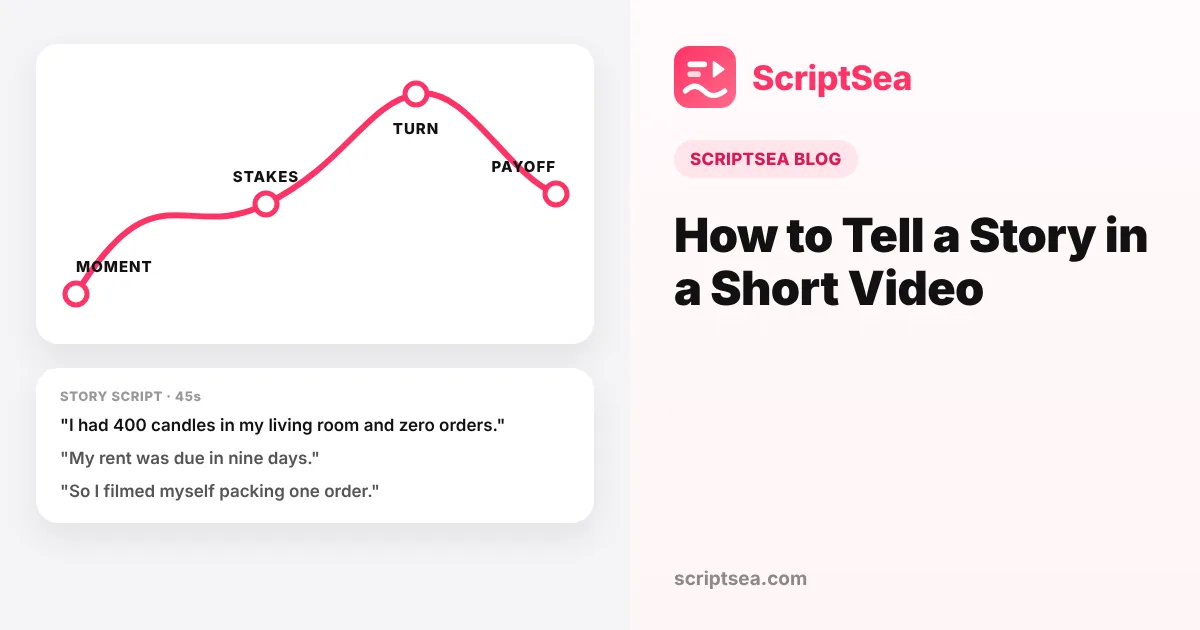
Most stories that work in video follow the same four beats:
| Beat | What it does | Share of the video |
|---|---|---|
| The moment | Drops the viewer into the most tense or surprising point | First 5 to 10% |
| The stakes | Shows why it matters and what could go wrong | About 25% |
| The turn | Something changes, a decision, a twist, a surprise | About 40% |
| The payoff | How it ended and what it means | Last 20 to 25% |
It's the classic story shape, squeezed for short attention spans. The big difference is the first beat: you don't start at the beginning. You start at the best part.
Beat 1: Start in the moment
The most common storytelling mistake is starting at the start. "So, back in 2022, I was working at a coffee shop..." By the time you get to the interesting part, people have gone.
Start at the moment of highest tension instead, then fill in the background.
Weak: "So last year I decided to start a small business selling candles."
Strong: "I had 400 candles in my living room and zero orders."
The strong version makes people ask how you got there and what happened next. The background can come in the next line.
Beat 2: Raise the stakes
Now give just enough background to make the moment matter. Who are you, what did you want, and what could go wrong?
Keep it short. One to three lines for a short video. The viewer doesn't need your whole history, only the parts that make the outcome matter.
"I'd spent my savings on wax and jars. My rent was due in nine days. And my launch post got four likes."
Specific details do the work here. "My savings" and "nine days" create pressure that "I was worried" never could.
Beat 3: The turn
This is the part people stay for. Something changes. A decision, a surprise, a mistake, a stroke of luck.
"So I did the one thing I'd been too embarrassed to do. I filmed myself packing an order. One order. For my mum."
The best turns feel surprising but make sense looking back. If your story doesn't have a big twist, the turn can be a choice: the moment you decided to do something different.
In longer videos, add small turns along the way. Each "but then" restarts the viewer's curiosity.
Beat 4: The payoff
Land the ending. Tell people how it turned out, and then, in one line, what it means.
"That video got 2 million views. I sold out in a weekend. The candles weren't the problem. Nobody knew I existed."
The last line is the lesson, but keep it short and earned. A long moral at the end feels like a lecture. One sharp line feels like a punchline.
For short videos, you can also end on a loop, a line that leads back into your opening, so the video replays smoothly.
A storytelling script template
Moment: "[The most tense or surprising point, in under 12 words.]"
Stakes: "[Who you were, what you wanted, what could go wrong. 1 to 3 lines.]"
Turn: "[What changed. The decision, twist or surprise.]"
Payoff: "[How it ended.]"
Meaning: "[One line on what it means, or a question for the viewer.]"
Full example: 45-second story
Here are the candle story's beats put together into one script:
"I had 400 candles in my living room and zero orders.
I'd spent my savings on wax and jars. My rent was due in nine days. And my launch post got four likes.
So I did the one thing I'd been too embarrassed to do. I filmed myself packing an order. One order. For my mum.
That video got 2 million views. I sold out in a weekend.
The candles were never the problem. Nobody knew I existed."
That's about 75 words. It starts at the worst moment, gives just enough context, turns on one decision and ends with a short, earned line.
Telling stories in longer YouTube videos
The same four beats work for a 10 or 20 minute video. You just repeat the middle.
- Open on the moment, then promise what the viewer will find out by the end.
- Break the story into chapters, each with its own small stakes and turn.
- End each chapter on an open question so people keep going.
- Save the biggest payoff for the end.
If you're scripting a long video, our guide on how to write a YouTube script covers re-hooks and pacing in more detail.
Make it feel real
- Use specific details. Names of places, real numbers, small objects. Details are what make a story believable.
- Show the feeling, don't name it. "I sat in my car for an hour" says more than "I was really sad".
- Cut the side stories. If a detail doesn't affect the ending, drop it.
- Say it the way you'd tell a friend. Short sentences, contractions, pauses before the turn.
- Keep it honest. If a story is made up or changed for the video, don't present it as something that happened to you.
Storytelling mistakes to avoid
- Starting at the beginning instead of the best moment.
- Too much background before anything happens.
- No clear turn, so the story just drifts to an end.
- A long moral that lectures the viewer.
- Too many characters or side plots for the length of the video.
Get a story script in seconds
Turning a messy memory into a tight story is hard. ScriptSea takes your idea and writes a hook-first story script at the length you pick, starting in the moment and ending on a payoff. If you'd rather find your opening line first, try the free Video Hook Generator.
Try ScriptSea free
ScriptSea writes story scripts, hooks and full video scripts for TikTok, Reels, Shorts and YouTube, plus AI video prompts for every scene. Try ScriptSea free. You get 3 free scripts, no card needed.