A long YouTube video lives or dies in two places: the first 30 seconds and every point where the viewer could get bored. A good script plans for both before you ever press record.
Most people script long videos like an essay. Intro, background, points, conclusion. That works on paper and fails on YouTube, because the viewer can leave at any second and there's always another video in the sidebar.
Here's a step-by-step way to write a YouTube script for 8 to 20 minute videos, with a template you can copy and an example opening.
Why long videos need a different script
On a Short, you're fighting for the next two seconds. On a long video, you're fighting for the next two minutes, over and over.
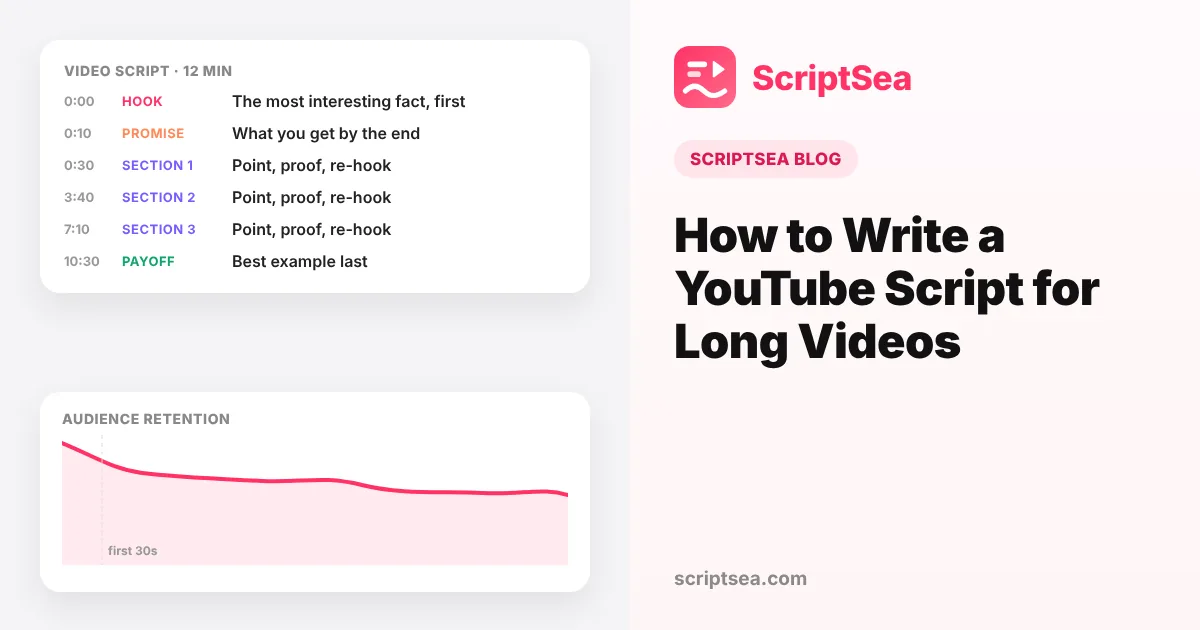
YouTube Studio shows this clearly. The audience retention report has a "key moments" section, and the first thing it measures is your intro: how many people were still watching after the first 30 seconds. YouTube's own advice when that number is low is to make sure the title and thumbnail match what the video delivers, and to try different styles for the first 30 seconds.
After the intro, the report shows dips, where people skipped or left. A script can't stop every dip. But it can stop the big ones, which almost always come from the same few things: a slow start, a long stretch with no new information, and an ending that tells people the video is over before it is.
Step 1: Start with the promise
Before you write a word, finish this sentence: "By the end of this video, you'll know..."
That's your promise. Your title and thumbnail make it. Your first 30 seconds confirm it. Every section after that delivers part of it.
If you can't finish the sentence clearly, the video isn't ready to script. Narrow the topic until you can.
Step 2: Write the first 30 seconds
The opening has three jobs, in this order:
- Hook. Say the most interesting thing first. A result, a surprise or a problem, in one line.
- Promise. Confirm what the viewer will get, and why it's worth their time.
- Start. Jump straight into the first point. No long intro, no channel trailer.
Hook: "I lived on $10 a day in London for a month, and the hardest part wasn't the food."
Promise: "I'll show you exactly what I bought, what I'd never do again, and the one trick that saved me $60."
Start: "Day one started in a supermarket at 9pm, because that's when the yellow discount stickers come out."
Notice there's no "hey guys" and no "before we start". The viewer clicked because of the title. The first line should feel like you're picking up exactly where the thumbnail left off.
Save the subscribe request for later. Asking before you've given anything is the fastest way to lose people in the intro.
Step 3: Plan the body in sections
Break the rest of the video into 3 to 6 sections. Each one should answer one question or make one point.
A simple way to find your sections: write down every question your viewer would ask about the topic, then put them in the order a curious person would ask them. That order is your outline.
For each section, write:
- The point in one sentence
- The proof: an example, a number, a story or a demo
- The visual: what's on screen while you say it
Keep each section tight. If a section runs longer than three or four minutes, it's probably two sections.
Step 4: Add a re-hook between every section
This is the step most scripts skip, and it's the one that holds people in the middle.
A re-hook is one or two lines at the end of a section that give the viewer a reason to stay for the next one.
"So that's how I handled food. But it doesn't explain my transport bill, and that part surprised me."
You can also open a loop early and close it late:
"There's one thing I did in week three that sounds crazy. I'll get to it near the end."
Now there's a reason to keep watching. Just make sure you pay it off. A loop you never close feels like a trick.
Step 5: Write the way you talk
A YouTube script is spoken, so write it for the ear:
- Short sentences. Most should be under 15 words.
- Contractions. "It's", "you'll", "don't". The way people actually talk.
- "You", not "viewers". Talk to one person.
- One idea per sentence. If a sentence has two commas and an "and", split it.
Read every section out loud before you record. Anywhere you trip, rewrite. Anywhere you get bored reading it, your viewer will get bored hearing it.
Step 6: Script the visuals too
Long videos lose people when the screen sits still. Next to each line or paragraph, note what the viewer sees: B-roll, a graphic, a screen recording, a close-up, a map.
Aim for the picture to change every few seconds, even in a talking video. A cut to a new angle or a simple on-screen number is enough. If you make visuals with AI, a scene-by-scene shot list makes writing prompts much faster. Our guide on how to write AI video prompts shows how.
Step 7: Land the ending
Don't signal the end before it arrives. Lines like "so, to wrap up" or "that's it for today" tell people they can leave, and many will, right before your call to action.
Instead:
- Pay off the promise. Deliver the final answer or the best example last.
- Close any open loops.
- Point to the next video. One line, and make it a real reason: "If you want to see me try the same thing in Tokyo, that's this video here."
The best place for a subscribe request is right after a moment of real value, not at the very start or the very end.
How long should a YouTube script be?
Most people speak at roughly 130 to 160 words a minute on camera. That gives you a rough guide:
| Video length | Script length |
|---|---|
| 5 minutes | about 650 to 800 words |
| 10 minutes | about 1,300 to 1,600 words |
| 15 minutes | about 2,000 to 2,400 words |
| 20 minutes | about 2,600 to 3,200 words |
Write the first draft long, then cut. The parts to cut first are background the viewer doesn't need and sentences that repeat what you just said.
A simple YouTube script template
Copy this structure and fill it in:
| Part | Length | What goes in it |
|---|---|---|
| Hook | 1 to 2 lines | The most interesting fact, result or problem |
| Promise | 1 to 2 lines | What the viewer gets by the end |
| Section 1 | 1 to 3 min | First point, proof, visual, then a re-hook |
| Section 2 | 1 to 3 min | Second point, proof, visual, then a re-hook |
| Section 3 | 1 to 3 min | Third point, proof, visual, then a re-hook |
| Payoff | 1 to 2 min | The best example or final answer, close open loops |
| Next video | 1 line | A specific reason to watch your next video |
Add more sections for longer videos. Keep the shape the same.
Common YouTube script mistakes
- A long intro. Background, greetings and channel plugs before the point.
- A title the video doesn't deliver. People notice fast, and the intro number drops.
- No re-hooks. Each section ends flat, so people drift off between them.
- Reading like an essay. Long sentences that sound fine written and dull spoken.
- The best part first and nothing after. Spread the good parts out, and save one for the end.
- Ending early. "That's all for today" two minutes before the video actually ends.
Let a tool write the first draft
Outlining and drafting is the slow part. Our YouTube Script Generator writes a hook-first script timed to your video length, with sections and an ending. If you run a channel without showing your face, the free Faceless YouTube Script Generator is built for voiceover videos. Either way, edit the draft in your own words before you record.
Try ScriptSea free
ScriptSea writes scripts for long videos and Shorts, timed to your length, and turns every scene into a ready AI video prompt if you make your visuals with AI. Try ScriptSea free. You get 3 free scripts, no card needed.